Setting the Standard for Women in Firearms | Training. Insights. Intelligence.

1. New Shooter Zone: Amber Track

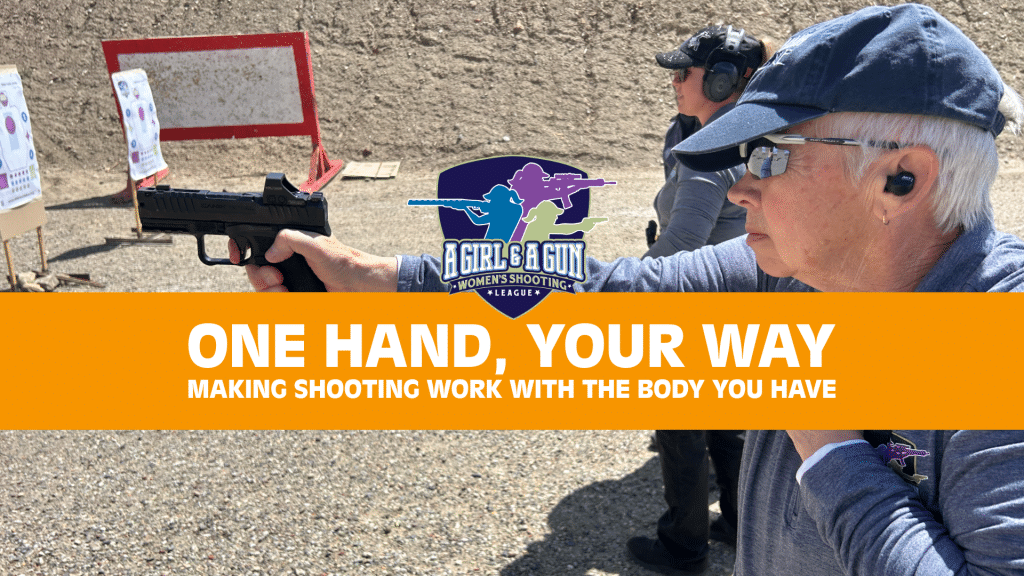
Yes, You Can Shoot With One Hand

Strong-hand-only shooting tends to look much more intimidating than it actually is. Your strong hand is already holding the pistol, operating the trigger, and doing much of the important work behind every shot. Your support hand certainly helps. It adds stability and plays a significant role in recoil control and recovery. Take it away and the pistol will feel different and yes, it will move more. The good news is that different does not mean unmanageable.

In fact, the biggest hurdle often happens before the first shot is ever fired. The brain is wonderfully creative when given an opportunity to imagine recoil. You brace for it, add tension, squeeze harder, and prepare for the pistol to do something far more dramatic than what is actually about to happen. Then the shot fires and the reaction is often, “Oh. That was it?”

Successful one-handed shooting is not about being stronger or muscling the pistol into submission. The real game changer is knowing what to expect and having the right technique to manage what the gun actually does. Give one hand the right job, build good structure behind the pistol, and let solid fundamentals do the rest.

Read More »
1. New Shooter Zone: Amber Track

Drill of the Month: Kelly’s 3×3 Reload Challenge

Some of the best drills are born from a simple idea, a handful of ammunition, and a shooter who looks at the range and thinks, “You know what would make this more interesting?”

Meet Kelly Palomera from the Southern Maine Chapter. Kelly has been a vital part of the Southern Maine A-Team for the past five years. She is an avid pistol shooter, a certified NRA pistol instructor, a Chief Range Safety Officer (CRSO), and a NRA certified shotgun instructor who also teaches shotgun through L.L.Bean’s women’s programs to name a few of her shooting accomplishments. She is inventive, creative, always ready for a challenge, and exactly the kind of person you want dreaming up new ways to keep range day interesting.

This month, we are featuring one of Kelly’s creations: a deceptively simple drill that combines accuracy, reloads, target transitions, mental processing, and a little friendly competition.

It can be run as an individual challenge, a head-to-head competition, or a chapter activity. Better yet, it is easy to modify for different shooter skill levels.

Read More »
1. New Shooter Zone: Amber Track

Build Skills With Purpose: The A Girl & A Gun Marksmanship Programs

Improve your shooting skills with A Girl & A Gun’s Pistol Marksmanship Program (PMP) and Defensive Marksmanship Program (DMP). Learn how these structured firearms training programs help shooters build accuracy, confidence, defensive skills, and measurable progress through guided practice. Discover which program is right for your experience level and how purposeful range training leads to long-term marksmanship success.

Read More »
1. New Shooter Zone: Amber Track

A Beginner’s Guide to Target Transitions

Target transitions are one of the most enjoyable skills you will learn because they add movement, problem-solving, and rhythm to your shooting, even when your feet stay still. Instead of simply firing one accurate shot after another, you are learning to shift your attention, move the pistol with purpose, and build a new sight picture for the next shot. It feels like a natural next step because it is. The same fundamentals that helped you become an accurate shooter are still at work. You are simply learning how to connect them from one target to the next.

Read More »
1. New Shooter Zone: Amber Track

Common Pistol Malfunctions: A Beginner’s Guide to Safe Gun Handling

A pistol malfunction is a normal part of shooting, and every new shooter should know how to recognize common handgun malfunctions and respond safely. This guide explains the most common pistol stoppages, including failure to fire, failure to feed, failure to eject (stovepipe), and the critical squib load, while emphasizing that safety always comes before speed. Rather than reacting impulsively, shooters should keep the muzzle pointed in a safe direction, remove their finger from the trigger, assess the situation, and seek help from an instructor or Range Safety Officer when needed. By understanding the causes of common firearm malfunctions and learning to identify them before attempting to clear them, beginners build safer habits, greater confidence, and a stronger foundation for responsible handgun ownership and marksmanship.

Read More »
1. New Shooter Zone: Amber Track

Does This Gun Actually Fit You?

Every recommendation is usually well intentioned. Unfortunately, none of those people have your hands. Gun buyers’ remorse is incredibly common, and more often than not it has nothing to do with reliability, accuracy, or quality. It comes from purchasing a firearm that simply doesn’t fit the shooter.

The result? The controls feel awkward. Reloads become frustrating. The slide is difficult to manipulate. The grip requires constant adjustment. Every repetition feels like work instead of becoming intuitive. Many shooters assume they’ll “grow into it.” Within reason, sometimes they do. More often, they spend years adapting themselves to a gun that was never designed for their proportions in the first place.

The good news is that you don’t have to guess. Before you spend a dollar or fire a single round, your hands can tell you whether a handgun truly fits. All you need is a simple, objective evaluation that separates personal preference from mechanical fit.

Read More »
1. New Shooter Zone: Amber Track

What’s That Lever For?

Mechanical safeties and decocking levers are important firearm features, but they serve different purposes and should never replace safe gun handling practices. A mechanical safety helps prevent a firearm from firing by blocking part of the firing mechanism, while a decocking lever safely lowers the hammer on certain double-action/single-action pistols without firing a round. Because firearm safety systems vary by manufacturer and model, some guns have external thumb safeties, while others rely on internal safety mechanisms or combine safety and decocking functions. Understanding how your specific firearm operates is essential, as no mechanical device can substitute for following the fundamental rules of firearm safety, including keeping the muzzle pointed in a safe direction, keeping your finger off the trigger until ready to shoot, and knowing your target and what is beyond it. By learning your firearm’s controls, reading the owner’s manual, and training with qualified instructors, you can build the confidence and knowledge needed to handle firearms safely and responsibly.

Read More »
All Articles & Videos

Stronger Hands, Better Shooting: 10 Exercises Every Shooter Over 45 Should Be Doing

If your grip is failing, your shooting is already telling you. Maybe your sights don’t track the way they used to. Maybe your hands fatigue faster than they should. Maybe your trigger press feels inconsistent. That is not random. That is your body asking for attention. For women 45 and up, this matters even more. We are not chasing strength for the sake of it. We are building strength with purpose and protecting it with smart, consistent movement. These drills are practical, effective, and built for real life. Stay consistent, and your hands will show up for you when it matters most.

Read More »
All Articles & Videos

The Big Picture of “Load and Make Ready”

Whether you’re practicing at the range, training for concealed carry, getting ready for home defense, or stepping up to the line in competition, how you load your firearm matters. It sets the tone for your performance, your safety, and your confidence. In this article, we’ll break down the big picture of Load and Make Ready.

Read More »
All Articles & Videos

Buying Your First Firearm: Tips for a Safe, Stress-Free Experience

Walking into a gun shop for the first time can be exciting, and a little nerve-wracking. The glass cases are full of options, the counter is lined with choices, and it can feel like you’re supposed to “already know everything.”

Here’s what experienced retail staff and trainers wish every first-time buyer knew and how you can make the process fun, educational, and safe for everyone involved.

Read More »
All Articles & Videos

Preventing Firearm Suicides: How Education and Community Make a Difference

Firearms are a crucial tool for self-defense, and when paired with education, community support, and safe storage, they save lives. The CDC cites more than 2 million defensive gun uses (DGUs) per year; however, there are also tragedies involving firearms that can be prevented. Nearly 60 percent of all firearm-related fatalities are suicides, highlighting the importance of providing emotional support, resources, and education on safe storage options. By combining knowledge, community engagement, and responsible practices, firearm owners can help save lives while protecting their rights and the safety of those around them.

Read More »
All Articles & Videos

Shooting Strong with Changing Vision

One of the most overlooked safety factors in shooting isn’t grip, stance, or trigger control, it’s your vision. The truth is, your eyes are just as much a part of the shooting equation as your firearm, and they change over time. Age, corrective surgeries, and common conditions like cataracts, astigmatism, and monovision can alter how you see the world and how you see your sights.

But here’s the good news: vision changes shouldn’t stop you from enjoying your time on the range or from maintaining the defensive skills that protect you and your family. You can adapt. With the right tools and a few strategic adjustments, you can extend your shooting longevity, keep your confidence high, and make sure that both the fun and the defensive capability stay firmly within your reach.

Read More »
All Articles & Videos

Shooting with Both Eyes Open: Unlocking Your Full Field of View

For many shooters, the idea of firing with both eyes open feels counterintuitive. You’ve been told for years to “close one eye and focus on the sights” so you can cut out distractions and aim more precisely. That works, up to a point. But if you want to unlock faster target acquisition, better situational awareness, and reduced fatigue, it’s time to train yourself to shoot with both eyes open.

This skill isn’t just for competitive shooters or operators it’s a tool every marksman can benefit from, whether you’re on the range, in the field, or preparing for self-defense.

Read More »
All Articles & Videos

Mastering Iron Sights: The Key to Consistent, Accurate Shooting

Even in an era of cutting-edge red dots and optics, iron sights remain the constant; always powered, always present. Mastering them isn’t just for beginners, it’s a skill you’ll refine for a lifetime. The stronger your foundation with irons, the better you’ll perform with any sighting system that follows.

Read More »
All Articles & Videos

Trust the Dot: Three Ways to Read It, One Way to Win

There’s a moment, usually right around your first few live-fire reps with a red dot, when you realize this thing isn’t behaving like your iron sights. The red dot doesn’t track the same; it doesn’t “sit” neatly on your front sight post, and sometimes it dances, flares, or appears to vanish entirely. That is usually the exactly moment when many shooters start to second-guess the choice to transition from irons to optics. But take heart, you’re not doing anything wrong. You’ve stepped into a new visual language, and once you learn how to read it, the dot becomes an incredible tool for precision, speed, and adaptability. Let’s talk about what that new visual world looks like and how to work with it.

Read More »
All Articles & Videos

The Truths About Lead

Listen to Mike’s surprising journey to offer safe solutions for families and individuals exposed to lead and other toxic metal poisoning. What makes a guy want to change careers and get face-to-face with lead, mercury, cadmium, zinc, chromium, arsenic, silver, selenium, cobalt, and other minerals? In this presentation, you’ll learn from the expert helpful information and strategies you can use to avoid contaminants at the range, and home, and anywhere you handle your ammunition or firearms.

Read More »
All Articles & Videos

Trigger Control with Tatiana Whitlock

Trigger control is the act of manipulating the trigger to fire the gun without disturbing your sight alignment. In this Virtual Girls Night Out, Tatiana Whitlock gives you tricks and tips on how to have the best results with your pistol.

Read More »
All Articles & Videos

No Range, No Problem: Essential At-Home Training for All Skill Levels

Life often presents unexpected challenges that can disrupt your time at the range, whether it’s due to bad weather, unforeseen events, or the need to recover from an illness or injury. Don’t be discouraged if you’re unable to attend Chapter events. Just because you can’t visit the range doesn’t mean that all the hard work you’ve invested in your shooting practice is in vain. We have a plan and resources to help you continue your training, whether you’re on a short or long hiatus. Regardless of the reason for your absence, there are effective ways to keep your skills sharp and gain new insights without visiting a live-fire range. Here’s how you can make the most of your AG & AG membership and training opportunities when accessing the range isn’t feasible.

Read More »
All Articles & Videos

Ammo Safety Check: What Every Shooter Needs to Know

One of the simplest yet most important habits you can develop as a new shooter is inspecting your ammunition before use. Think of it as part of your pre-flight checklist—a small step that ensures a safe and smooth experience at the range. Ammunition defects are rare but not impossible, and overlooking a problem round can lead to frustrating malfunctions or even dangerous situations. Giving your ammo a thorough once-over sets you up for success and reinforces your commitment to safe shooting practices.

Read More »
All Articles & Videos

How to Safely Ask for Help at the Range

Asking for help at the range isn’t just smart—it’s a critical safety skill. No one wants an awkward encounter with the Range Safety Officer (RSO) because of an uncertain moment with a firearm. There are plenty of reasons to speak up, from equipment malfunctions and unfamiliar guns to dropped gear or trouble with electronic controls at indoor ranges. Whether you’re a new shooter or have years of experience, knowing how to safely manage your firearm while seeking help and communicating respectfully with range staff will ensure a safer and smoother experience for everyone.

Read More »
All Articles & Videos

Lead Exposure and Lowering Lead Levels

In February 2024, Ranae Knapp learned that her bloodwork showed a lead level of 37.7. A normal level is below 5. She got to work researching the effects of high lead levels, how to counteract lead, and what steps she could take to protect herself. 

Read More »
All Articles & Videos

5 Basics of Accurate Shooting

When shooting a handgun, there are 5 basics of accurate shooting. These simple factors, when focused upon, will dramatically improve shooting accuracy.

Read More »

Articles & Videos

Categories

Search

Skillsets