Setting the Standard for Women in Firearms | Training. Insights. Intelligence.

1. New Shooter Zone: Amber Track

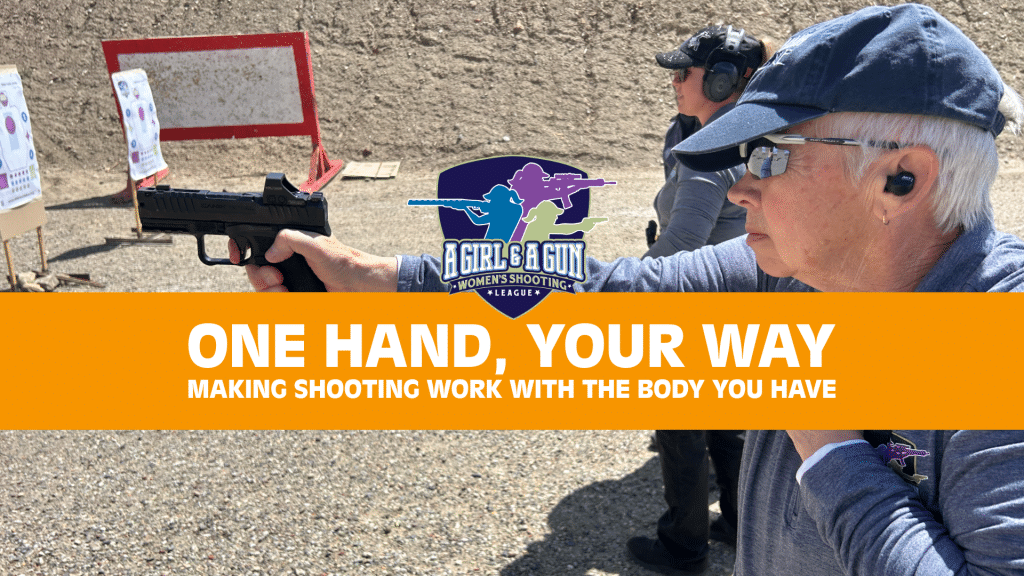
Yes, You Can Shoot With One Hand

Strong-hand-only shooting tends to look much more intimidating than it actually is. Your strong hand is already holding the pistol, operating the trigger, and doing much of the important work behind every shot. Your support hand certainly helps. It adds stability and plays a significant role in recoil control and recovery. Take it away and the pistol will feel different and yes, it will move more. The good news is that different does not mean unmanageable.

In fact, the biggest hurdle often happens before the first shot is ever fired. The brain is wonderfully creative when given an opportunity to imagine recoil. You brace for it, add tension, squeeze harder, and prepare for the pistol to do something far more dramatic than what is actually about to happen. Then the shot fires and the reaction is often, “Oh. That was it?”

Successful one-handed shooting is not about being stronger or muscling the pistol into submission. The real game changer is knowing what to expect and having the right technique to manage what the gun actually does. Give one hand the right job, build good structure behind the pistol, and let solid fundamentals do the rest.

Read More »
All Articles & Videos

Dry Fire Training: The Complete Guide to Practicing at Home and Choosing the Right Training Aids

Dry-fire practice is one of the simplest ways to stay connected to your skills between range days, and for A Girl & A Gun members, it is also an opportunity to learn more about how your firearm, your gear, and your body work together. A few focused minutes can reveal whether your grip is consistent, whether your sights come into view the way you expect, whether your holster is truly working for you, and whether the skills you rely on feel as familiar as they should. Because confidence is built through repetition, not assumption, making dry fire part of your regular training routine can help turn occasional practice into lasting proficiency.

Read More »
3. Formidable Holster Skills: Green Track

Transitioning Between Firearms

Most of us don’t own just one gun. We have the gun we love to shoot at the range, the gun we carry and maybe a different gun for home defense. There might be a winter carry gun and a smaller summer option. Many of us also have a variety of competition guns, too. Others have a deep-concealment setup as well as an off-body concealed carry pistol option. Then there are rifles and shotguns, each with their own jobs and personalities. Over time, we build a collection of firearms dedicated to different tasks.

Which is great. Until you pick up one you haven’t worked with in a while and suddenly discover that your hands have apparently never operated a firearm before. Welcome to the wonderfully humbling business of transitioning between guns.

Read More »
All Articles & Videos

Revolvers and Cartridge Types: Rimmed vs. Rimless

What’s the difference between rimmed and rimless ammunition, and why does it matter? If you’re learning about revolvers, semi-automatic pistols, or handgun ammunition, understanding the difference is a great place to start. Learn how to identify rimmed and rimless cartridges, why each design is used, how the cartridge works with the firearm, and what to look for before choosing ammunition for your firearm.

Read More »
All Articles & Videos

Before You Need That Phone Call: Understanding Self-Defense Legal Plans and Insurance

Self-defense is about more than choosing the right firearm and learning how to shoot. Understanding self-defense legal plans, concealed carry insurance, firearms instructor insurance, and the potential legal and financial aftermath of a defensive incident is another important part of being prepared. Using data from 1,239 A Girl & A Gun members, this guide explores what women gun owners are actually choosing, the common self-defense legal protection and instructor insurance brands they encounter, what these products may and may not cover, and the questions every gun owner should ask before spending her money. Whether you already have a self-defense legal plan or are among the nearly 62% of surveyed members who said “None or not yet,” this guide will help you understand your options and make a more informed decision before you ever need to make that phone call.

Read More »
All Articles & Videos

A Girl & A Gun Sniper School Combines Riflecraft and Fieldcraft in Training Designed for Women

Seventeen women took on four intensive days of long-range shooting, fieldcraft, observation, and teamwork at A Girl & A Gun Sniper School in Raton, New Mexico. By the end of the program, more than half had successfully engaged a target at one mile, an extraordinary achievement that reflected far more than marksmanship. Each hit represented reliable data, careful problem-solving, confident communication, and the determination to keep learning as the challenges grew.

Read More »
1. New Shooter Zone: Amber Track

Drill of the Month: Kelly’s 3×3 Reload Challenge

Some of the best drills are born from a simple idea, a handful of ammunition, and a shooter who looks at the range and thinks, “You know what would make this more interesting?”

Meet Kelly Palomera from the Southern Maine Chapter. Kelly has been a vital part of the Southern Maine A-Team for the past five years. She is an avid pistol shooter, a certified NRA pistol instructor, a Chief Range Safety Officer (CRSO), and a NRA certified shotgun instructor who also teaches shotgun through L.L.Bean’s women’s programs to name a few of her shooting accomplishments. She is inventive, creative, always ready for a challenge, and exactly the kind of person you want dreaming up new ways to keep range day interesting.

This month, we are featuring one of Kelly’s creations: a deceptively simple drill that combines accuracy, reloads, target transitions, mental processing, and a little friendly competition.

It can be run as an individual challenge, a head-to-head competition, or a chapter activity. Better yet, it is easy to modify for different shooter skill levels.

Read More »
2. Mastering Fundamentals: Blue Track

Faster Target Transitions: 3 Ways to Improve Shooting Efficiency

Once target transitions start to feel comfortable, most shooters want the same thing next: more speed. Instead of chasing speed, start cleaning up the process. Efficient target transitions depend on your eyes and hands working together. Your vision identifies where the pistol needs to go next, then your hands deliver it there. As that relationship improves, unnecessary movement and hesitation begin to disappear. For most developing shooters, there are three places where this work can make a noticeable difference.

Read More »
All Articles & Videos

Finally, a Clear Picture of the Women’s Sporting Clays Market

Discover exclusive data on what women sporting clays competitors are actually buying. At the 2026 A Girl & A Gun Women’s Clays Extravaganza, 107 women from 12 states participated in a comprehensive Gear Check, creating one of the most detailed datasets available on women’s purchasing decisions in the shooting sports. From shotgun brands like Beretta, Syren, and Browning to performance eyewear, hearing protection, shooting vests, shell pouches, and accessories, the findings reveal how experienced women invest in equipment that improves comfort, fit, and competitive performance. As one of the largest women-only registered NSCA sporting clays events, the Women’s Clays Extravaganza provides manufacturers, retailers, and industry partners with valuable market insights into the fastest-growing segment of competitive shooting. Explore the trends shaping women’s sporting clays equipment purchases and learn what this benchmark data reveals about the future of the shooting sports industry.

Read More »
1. New Shooter Zone: Amber Track

Build Skills With Purpose: The A Girl & A Gun Marksmanship Programs

Improve your shooting skills with A Girl & A Gun’s Pistol Marksmanship Program (PMP) and Defensive Marksmanship Program (DMP). Learn how these structured firearms training programs help shooters build accuracy, confidence, defensive skills, and measurable progress through guided practice. Discover which program is right for your experience level and how purposeful range training leads to long-term marksmanship success.

Read More »
1. New Shooter Zone: Amber Track

A Beginner’s Guide to Target Transitions

Target transitions are one of the most enjoyable skills you will learn because they add movement, problem-solving, and rhythm to your shooting, even when your feet stay still. Instead of simply firing one accurate shot after another, you are learning to shift your attention, move the pistol with purpose, and build a new sight picture for the next shot. It feels like a natural next step because it is. The same fundamentals that helped you become an accurate shooter are still at work. You are simply learning how to connect them from one target to the next.

Read More »
3. Formidable Holster Skills: Green Track

Beyond the Malfunction

Then something interesting happens. The mechanics are no longer the challenge. The questions simply change. Experienced shooters eventually discover that restoring the firearm to operation is only half the lesson. The more valuable question is, Why did it stop in the first place? That shift marks an important stage in a shooter’s development. The goal is no longer to simply solve the problem. The goal is to understand it well enough to keep it from happening again. That is where some of the most valuable conversations in advanced training begin.

Read More »
All Articles & Videos

Weight Loss and the Shooting Sports: The Side Effects Nobody Warns You About

Losing a significant amount of weight can dramatically improve your health, but it can also change the way your shotgun fits your body. As your body composition changes, factors like length of pull, cheek weld, recoil management, balance, and gun mount all shift, often leading to missed targets and unexpected discomfort. This article explains why weight loss affects shotgun fit, how it impacts shooting performance, and the simple adjustments that can help you regain consistency and confidence on the range.

Read More »
All Articles & Videos

What Women Want from Their Pistols: Insights from Gear Check Data

What can a woman’s pistol tell you about her journey as a shooter? More than you might think. Drawing on A Girl & A Gun’s Gear Check data, this article examines the predictable progression of the upgrades women make and what those choices reveal about training, purchasing behavior, and skill development. Whether you’re an instructor helping students make smart equipment decisions or a manufacturer designing the next generation of products, these insights offer a data-informed look at how women invest in gear that supports meaningful progress, not passing trends.

Read More »
All Articles & Videos

A Girl & A Gun Women’s Clays Extravaganza Opens Defender Outdoors Clay Sports Ranch’s New Home with Historic First Registered Shoot

The 6th Annual A Girl & A Gun Women’s Clays Extravaganza brought 107 women from 12 states to Defender Outdoors Clay Sports Ranch in Joshua, Texas, July 17-19, 2026, for a record-setting weekend of competition and training. As the first registered National Sporting Clays Association (NSCA) event hosted at Defender’s new facility, competitors shot more than 26,000 registered targets while women of every experience level, from first-time competitors to Master Class shooters, participated in competitive events and optional instructional clinics. The event highlighted A Girl & A Gun’s mission to grow women’s participation in the shotgun sports by providing a welcoming environment for learning, competition, and community.

Read More »
All Articles & Videos

Understanding and Practicing Malfunctions with Purpose: Virtual GNO

Every shooter begins with the same goal: make the gun fire accurately and consistently. We spend countless hours learning grip, stance, sight alignment, trigger control, and recoil management. Those are the skills that get us started. Eventually, however, every shooter reaches the same inevitable reality. Firearms are mechanical tools, and mechanical tools occasionally stop working as expected.

During this Virtual Girls’ Night Out presentation, Tatiana Whitlock, Director of Training for A Girl & A Gun, explored an often overlooked but critically important part of becoming a confident shooter: understanding malfunctions and practicing how to solve them with purpose.

Read More »
3. Formidable Holster Skills: Green Track

When the Gun Stops

One of the greatest misconceptions in shooting is that confident shooters never encounter problems. They do. The difference is that they don’t interpret every unexpected event as a crisis. They understand that equipment, ammunition, weather, fatigue, distractions, and even human performance are all variables that can influence the outcome of a training session. Rather than fighting reality, they learn to work through it.

That mindset is one of the defining characteristics of a Green Track shooter. Success is no longer measured by whether everything goes according to plan. It is measured by the ability to remain thoughtful, observant, and disciplined when it doesn’t.

Read More »
All Articles & Videos

Should You Choose a Handgun with a Mechanical Safety?

Should you choose a handgun with a mechanical safety? It’s one of the most common questions new firearm owners ask. Some handguns have an external mechanical safety, while others rely on internal safety systems or a decocking lever. This guide explains the differences, how each system works, and how to safely operate your firearm according to its manual of arms.

Read More »
2. Mastering Fundamentals: Blue Track

Pistol Malfunctions: Recognize. Diagnose. Respond.

Learning to identify and safely clear common pistol malfunctions is an essential firearms skill that builds confidence, improves safety, and keeps shooters prepared when a handgun stops working. Rather than reacting immediately, shooters should first recognize the signs of a malfunction, diagnose the cause, and apply the correct response. This guide explains the differences between common pistol stoppages such as failure to fire, failure to feed, failure to eject (stovepipe), double feed, and the dangerous squib load, while emphasizing proper firearm safety procedures and when to seek assistance from a Range Safety Officer or qualified gunsmith. By following a consistent process of recognize, diagnose, and respond, shooters can safely troubleshoot handgun malfunctions, make better decisions under pressure, and develop reliable defensive shooting skills that apply across virtually any semi-automatic pistol.

Read More »
All Articles & Videos

The AG & AG Effect: How Experience Transforms Women’s Firearm Choices

Every firearm purchase tells the story of a shooter’s evolving journey. What begins with a first handgun often grows into a collection of firearms selected for concealed carry, home defense, training, competition, and recreation. Along the way, experience becomes the most valuable guide, shaping opinions about performance, reliability, ergonomics, and the brands that earn lasting trust. Recent A Girl & A Gun member surveys reveal how women make those decisions, showing that hands-on experience, trusted relationships, and a supportive community have far greater influence on purchasing behavior than advertising alone. The findings offer valuable insight into how firearm manufacturers can earn not only a customer’s first purchase, but also her long-term loyalty.

Read More »
1. New Shooter Zone: Amber Track

Common Pistol Malfunctions: A Beginner’s Guide to Safe Gun Handling

A pistol malfunction is a normal part of shooting, and every new shooter should know how to recognize common handgun malfunctions and respond safely. This guide explains the most common pistol stoppages, including failure to fire, failure to feed, failure to eject (stovepipe), and the critical squib load, while emphasizing that safety always comes before speed. Rather than reacting impulsively, shooters should keep the muzzle pointed in a safe direction, remove their finger from the trigger, assess the situation, and seek help from an instructor or Range Safety Officer when needed. By understanding the causes of common firearm malfunctions and learning to identify them before attempting to clear them, beginners build safer habits, greater confidence, and a stronger foundation for responsible handgun ownership and marksmanship.

Read More »
1. New Shooter Zone: Amber Track

Does This Gun Actually Fit You?

Every recommendation is usually well intentioned. Unfortunately, none of those people have your hands. Gun buyers’ remorse is incredibly common, and more often than not it has nothing to do with reliability, accuracy, or quality. It comes from purchasing a firearm that simply doesn’t fit the shooter.

The result? The controls feel awkward. Reloads become frustrating. The slide is difficult to manipulate. The grip requires constant adjustment. Every repetition feels like work instead of becoming intuitive. Many shooters assume they’ll “grow into it.” Within reason, sometimes they do. More often, they spend years adapting themselves to a gun that was never designed for their proportions in the first place.

The good news is that you don’t have to guess. Before you spend a dollar or fire a single round, your hands can tell you whether a handgun truly fits. All you need is a simple, objective evaluation that separates personal preference from mechanical fit.

Read More »
All Articles & Videos

AR-15 Rifle vs. 9mm PCC: What’s the Difference?

Many modern PCCs are built on the same AR platform as a traditional AR-15. They feel familiar in your hands, accept many of the same accessories, and operate with nearly identical controls. But while they share a common manual of arms, they were designed around two very different cartridges, and that single design decision influences everything from how they operate and how far they shoot effectively to the competitions they’re used for and the training required to use them effectively. Many of the handling skills transfer between the two platforms, but the ballistic performance, operating systems, and intended applications do not. This article takes a closer look.

Read More »
4. Running & Gunning: Orange Track

Mechanical Safeties and Decockers: Building Reliability Under Stress

Mechanical safeties and decockers are more than firearm features. When integrated into a consistent shooting process, they help shooters build safer, more reliable, and repeatable performance under pressure. Rather than treating these controls as isolated tasks, competitive and defensive shooters should incorporate disengaging the safety into the draw and presentation, and use the safety or decocker to reinforce the transition from engagement to assessment, movement, or holstering. As training becomes more complex through movement, target transitions, reloads, and decision-making, these integrated habits help maintain firearm control, improve consistency, and reduce errors. While speed is an important performance metric, long-term success depends on developing a reliable process that connects firearm manipulation, visual processing, decision-making, and safe gun handling into one seamless sequence, ultimately building confidence through disciplined, repeatable execution.

Read More »
3. Formidable Holster Skills: Green Track

The Decisions Behind the Lever

A mechanical safety or decocker does more than change the condition of a firearm. It can also reinforce the decisions that guide safe and responsible gun handling. By connecting these controls to intent, awareness, and accountability, shooters can develop a more thoughtful relationship with their firearm. Explore how safeties and decockers become physical expressions of the choices we make before, during, and after every shot.

Read More »
All Articles & Videos

Women Push Beyond the Limits at DRIFT Academy

Sixteen women from across the country gathered at Virginia International Raceway (VIR) for three days of intensive vehicle survival, personal protection, and tactical decision-making training during the 2026 DRIFT Academy, held June 9–11 at the world-renowned motorsports facility near Danville, Virginia.

Read More »
All Articles & Videos

How to Optimize Your Brain at the Range

Every time you draw a pistol, acquire your sights, press the trigger, manage recoil, or transition between targets, your nervous system is building and refining an internal model of what it expects to happen next. The shooters who improve the fastest aren’t necessarily the ones who shoot the most rounds. They’re often the ones who become exceptionally good at observing, predicting, evaluating, and adapting. Understanding this process can fundamentally change how you train.

Read More »
2. Mastering Fundamentals: Blue Track

Safety On, Safety Off

The most important safety on any firearm is not a lever, button, or switch. It is the person holding it. Mechanical safeties and decocking levers are valuable tools, but they do not make a firearm safe. They support safe firearm handling when used correctly and consistently. Like any tool, their effectiveness depends entirely on the skill and discipline of the shooter using them.

Read More »

Articles & Videos

Categories

Search

Skillsets