
“Okay, now switch hands.” Sounds simple enough yet it makes your heart skip a beat. Rationally, you know the same fundamentals apply to your non-dominant hand as they do to your regular dominant hand, but you’ve yet to test-drive the other side. In your support hand, the grip feels like it’s somebody else’s. Your trigger finger acts socially awkward, like it’s meeting the trigger at a networking event. And a small voice in the back of your head asks the question every nervous shooter asks: What if the gun jumps right out of my hand?
That fear is completely normal, and it doesn’t mean you’re bad at this. Yet as you get started and work through predictable new-shooter skills, a familiar thought shows up: My weak hand is terrible.
The good news here is that despite your inclination to accuse your support hand of being less talented, it isn’t. What it is, is inexperience. Your support hand has spent its whole shooting life literally in a supporting role. It has stabilized the grip and helped manage recoil, but the dominant hand got the starring job. Now it has been volun-told and promoted to lead. It has to establish the primary grip, operate the trigger, bring the sights to your eye, and keep the gun steady through the shot. Your dominant hand does all of that on autopilot because it has years of repetitions behind it. The support hand just hasn’t had its reps yet.

An important distinction exists between being able to perform a skill and being able to access that skill when the moment feels important. If you cannot consistently perform a drill during ordinary practice, there may be a technical skill problem to solve. If you can perform it all day long until someone starts watching, the technique may not be the first thing to fix. You may need to train the performance environment.
Practice being watched, being timed, shooting for a score when you only get one attempt. Practice noticing that you are nervous without treating those sensations like an emergency that makes you want to run and hide. Practice acknowledging a mistake, resetting, and giving the very next shot your full attention. Those annoying feelings of frustration, anxiety, self-consciousness, and doubt are real. Acknowledge them, learn from them, because they will likely be with you into the next round. Give them a metaphorical high-five, tell them to hold your mag, and get back to work.

Eye dominance in shooting is more complex than simply being right-eye, left-eye, or cross-dominant. Understanding sighting dominance, visual acuity, and sensory dominance can help shooters improve accuracy, adapt handgun and long-gun techniques, troubleshoot red-dot and sight-picture problems, and adjust as their vision changes over time.
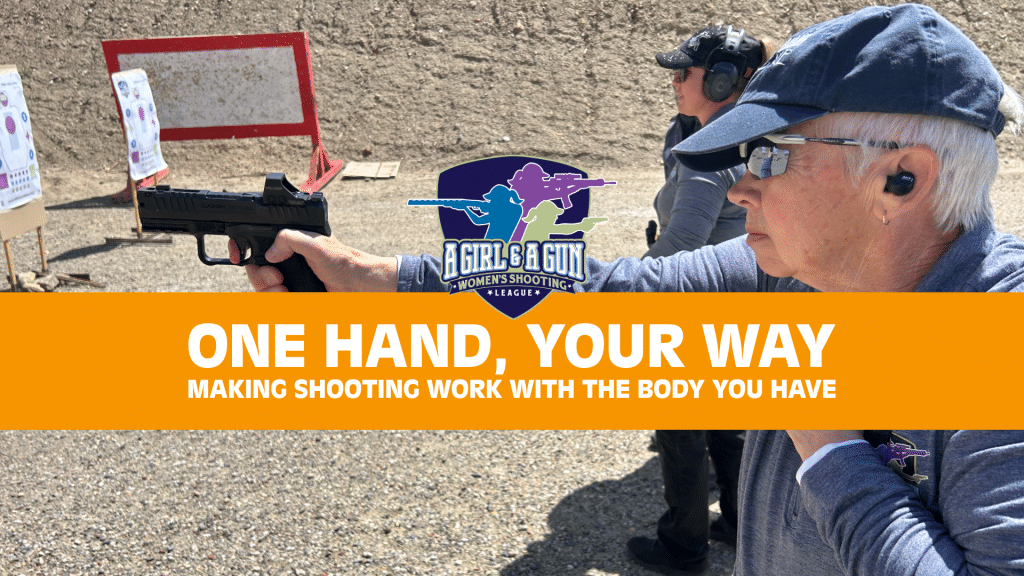
Maybe your hands do not work quite the way they used to. An injury or surgery may have left one wrist weaker than the other. Arthritis may have changed your grip. Neuropathy may have affected sensation. Or perhaps holding a handgun at full extension simply becomes tiring much faster than it once did. One-handed shooting can reveal these problems quickly. After all, the moment we remove one hand from the gun, we have also removed roughly half of our usual support, stability, and recoil management.

Strong-hand-only shooting has a wonderful way of telling the truth. When we shoot with two hands, the support hand contributes stability, grip pressure, and recoil management. That partnership is valuable, but it can also make it difficult to identify exactly what the strong hand is contributing to the shot. Remove the support hand and suddenly […]

Strong-hand-only shooting tends to look much more intimidating than it actually is. Your strong hand is already holding the pistol, operating the trigger, and doing much of the important work behind every shot. Your support hand certainly helps. It adds stability and plays a significant role in recoil control and recovery. Take it away and the pistol will feel different and yes, it will move more. The good news is that different does not mean unmanageable.
In fact, the biggest hurdle often happens before the first shot is ever fired. The brain is wonderfully creative when given an opportunity to imagine recoil. You brace for it, add tension, squeeze harder, and prepare for the pistol to do something far more dramatic than what is actually about to happen. Then the shot fires and the reaction is often, “Oh. That was it?”
Successful one-handed shooting is not about being stronger or muscling the pistol into submission. The real game changer is knowing what to expect and having the right technique to manage what the gun actually does. Give one hand the right job, build good structure behind the pistol, and let solid fundamentals do the rest.

Most of us don’t own just one gun. We have the gun we love to shoot at the range, the gun we carry and maybe a different gun for home defense. There might be a winter carry gun and a smaller summer option. Many of us also have a variety of competition guns, too. Others have a deep-concealment setup as well as an off-body concealed carry pistol option. Then there are rifles and shotguns, each with their own jobs and personalities. Over time, we build a collection of firearms dedicated to different tasks.
Which is great. Until you pick up one you haven’t worked with in a while and suddenly discover that your hands have apparently never operated a firearm before. Welcome to the wonderfully humbling business of transitioning between guns.

This month’s Virtual Girls Night Out featured Tatiana Whitlock, National Director of Training, exploring Target Transitions and how shooters move their attention, their eyes, and ultimately the gun from one shooting problem to the next. Transitions can look fast and athletic, but Tatiana emphasized that speed is not where the process begins. Efficiency is. See sooner, move with purpose, arrive predictably, and make a good shot.

The hardest moments in firearms instruction are rarely about the drill. They are about people. What do you do when a student repeatedly struggles with a safety standard, fatigue changes performance, a spectator begins coaching, or an experienced shooter challenges your instruction? More importantly, what do you actually say? This Instructor Mastermind session introduces a practical four-stage framework: Correct. Accommodate. Remove. Resolve. Through real-world scenarios, instructor language, and group discussion, we explore how to make difficult range decisions with confidence and professionalism while protecting safety, instructional quality, and individual dignity. Warmth in the delivery. Clarity in the words. Safety in the boundary.

Some of the best drills are born from a simple idea, a handful of ammunition, and a shooter who looks at the range and thinks, “You know what would make this more interesting?”
Meet Kelly Palomera from the Southern Maine Chapter. Kelly has been a vital part of the Southern Maine A-Team for the past five years. She is an avid pistol shooter, a certified NRA pistol instructor, a Chief Range Safety Officer (CRSO), and a NRA certified shotgun instructor who also teaches shotgun through L.L.Bean’s women’s programs to name a few of her shooting accomplishments. She is inventive, creative, always ready for a challenge, and exactly the kind of person you want dreaming up new ways to keep range day interesting.
This month, we are featuring one of Kelly’s creations: a deceptively simple drill that combines accuracy, reloads, target transitions, mental processing, and a little friendly competition.
It can be run as an individual challenge, a head-to-head competition, or a chapter activity. Better yet, it is easy to modify for different shooter skill levels.

Once target transitions start to feel comfortable, most shooters want the same thing next: more speed. Instead of chasing speed, start cleaning up the process. Efficient target transitions depend on your eyes and hands working together. Your vision identifies where the pistol needs to go next, then your hands deliver it there. As that relationship improves, unnecessary movement and hesitation begin to disappear. For most developing shooters, there are three places where this work can make a noticeable difference.

Improve your shooting skills with A Girl & A Gun’s Pistol Marksmanship Program (PMP) and Defensive Marksmanship Program (DMP). Learn how these structured firearms training programs help shooters build accuracy, confidence, defensive skills, and measurable progress through guided practice. Discover which program is right for your experience level and how purposeful range training leads to long-term marksmanship success.

Target transitions are one of the most enjoyable skills you will learn because they add movement, problem-solving, and rhythm to your shooting, even when your feet stay still. Instead of simply firing one accurate shot after another, you are learning to shift your attention, move the pistol with purpose, and build a new sight picture for the next shot. It feels like a natural next step because it is. The same fundamentals that helped you become an accurate shooter are still at work. You are simply learning how to connect them from one target to the next.

Then something interesting happens. The mechanics are no longer the challenge. The questions simply change. Experienced shooters eventually discover that restoring the firearm to operation is only half the lesson. The more valuable question is, Why did it stop in the first place? That shift marks an important stage in a shooter’s development. The goal is no longer to simply solve the problem. The goal is to understand it well enough to keep it from happening again. That is where some of the most valuable conversations in advanced training begin.

Every shooter begins with the same goal: make the gun fire accurately and consistently. We spend countless hours learning grip, stance, sight alignment, trigger control, and recoil management. Those are the skills that get us started. Eventually, however, every shooter reaches the same inevitable reality. Firearms are mechanical tools, and mechanical tools occasionally stop working as expected.
During this Virtual Girls’ Night Out presentation, Tatiana Whitlock, Director of Training for A Girl & A Gun, explored an often overlooked but critically important part of becoming a confident shooter: understanding malfunctions and practicing how to solve them with purpose.

One of the greatest misconceptions in shooting is that confident shooters never encounter problems. They do. The difference is that they don’t interpret every unexpected event as a crisis. They understand that equipment, ammunition, weather, fatigue, distractions, and even human performance are all variables that can influence the outcome of a training session. Rather than fighting reality, they learn to work through it.
That mindset is one of the defining characteristics of a Green Track shooter. Success is no longer measured by whether everything goes according to plan. It is measured by the ability to remain thoughtful, observant, and disciplined when it doesn’t.

Learning to identify and safely clear common pistol malfunctions is an essential firearms skill that builds confidence, improves safety, and keeps shooters prepared when a handgun stops working. Rather than reacting immediately, shooters should first recognize the signs of a malfunction, diagnose the cause, and apply the correct response. This guide explains the differences between common pistol stoppages such as failure to fire, failure to feed, failure to eject (stovepipe), double feed, and the dangerous squib load, while emphasizing proper firearm safety procedures and when to seek assistance from a Range Safety Officer or qualified gunsmith. By following a consistent process of recognize, diagnose, and respond, shooters can safely troubleshoot handgun malfunctions, make better decisions under pressure, and develop reliable defensive shooting skills that apply across virtually any semi-automatic pistol.

A pistol malfunction is a normal part of shooting, and every new shooter should know how to recognize common handgun malfunctions and respond safely. This guide explains the most common pistol stoppages, including failure to fire, failure to feed, failure to eject (stovepipe), and the critical squib load, while emphasizing that safety always comes before speed. Rather than reacting impulsively, shooters should keep the muzzle pointed in a safe direction, remove their finger from the trigger, assess the situation, and seek help from an instructor or Range Safety Officer when needed. By understanding the causes of common firearm malfunctions and learning to identify them before attempting to clear them, beginners build safer habits, greater confidence, and a stronger foundation for responsible handgun ownership and marksmanship.

Every recommendation is usually well intentioned. Unfortunately, none of those people have your hands. Gun buyers’ remorse is incredibly common, and more often than not it has nothing to do with reliability, accuracy, or quality. It comes from purchasing a firearm that simply doesn’t fit the shooter.
The result? The controls feel awkward. Reloads become frustrating. The slide is difficult to manipulate. The grip requires constant adjustment. Every repetition feels like work instead of becoming intuitive. Many shooters assume they’ll “grow into it.” Within reason, sometimes they do. More often, they spend years adapting themselves to a gun that was never designed for their proportions in the first place.
The good news is that you don’t have to guess. Before you spend a dollar or fire a single round, your hands can tell you whether a handgun truly fits. All you need is a simple, objective evaluation that separates personal preference from mechanical fit.

Mechanical safeties and decockers are more than firearm features. When integrated into a consistent shooting process, they help shooters build safer, more reliable, and repeatable performance under pressure. Rather than treating these controls as isolated tasks, competitive and defensive shooters should incorporate disengaging the safety into the draw and presentation, and use the safety or decocker to reinforce the transition from engagement to assessment, movement, or holstering. As training becomes more complex through movement, target transitions, reloads, and decision-making, these integrated habits help maintain firearm control, improve consistency, and reduce errors. While speed is an important performance metric, long-term success depends on developing a reliable process that connects firearm manipulation, visual processing, decision-making, and safe gun handling into one seamless sequence, ultimately building confidence through disciplined, repeatable execution.

A mechanical safety or decocker does more than change the condition of a firearm. It can also reinforce the decisions that guide safe and responsible gun handling. By connecting these controls to intent, awareness, and accountability, shooters can develop a more thoughtful relationship with their firearm. Explore how safeties and decockers become physical expressions of the choices we make before, during, and after every shot.

Every time you draw a pistol, acquire your sights, press the trigger, manage recoil, or transition between targets, your nervous system is building and refining an internal model of what it expects to happen next. The shooters who improve the fastest aren’t necessarily the ones who shoot the most rounds. They’re often the ones who become exceptionally good at observing, predicting, evaluating, and adapting. Understanding this process can fundamentally change how you train.

The most important safety on any firearm is not a lever, button, or switch. It is the person holding it. Mechanical safeties and decocking levers are valuable tools, but they do not make a firearm safe. They support safe firearm handling when used correctly and consistently. Like any tool, their effectiveness depends entirely on the skill and discipline of the shooter using them.

Mechanical safeties and decocking levers are important firearm features, but they serve different purposes and should never replace safe gun handling practices. A mechanical safety helps prevent a firearm from firing by blocking part of the firing mechanism, while a decocking lever safely lowers the hammer on certain double-action/single-action pistols without firing a round. Because firearm safety systems vary by manufacturer and model, some guns have external thumb safeties, while others rely on internal safety mechanisms or combine safety and decocking functions. Understanding how your specific firearm operates is essential, as no mechanical device can substitute for following the fundamental rules of firearm safety, including keeping the muzzle pointed in a safe direction, keeping your finger off the trigger until ready to shoot, and knowing your target and what is beyond it. By learning your firearm’s controls, reading the owner’s manual, and training with qualified instructors, you can build the confidence and knowledge needed to handle firearms safely and responsibly.

Understanding when you can legally and responsibly present a firearm is one of the most important parts of self defense training. This article breaks down the critical differences between a ready position, a defensive display, and unlawful brandishing in clear, real world terms. Learn how your intent, body language, movement, and decision making can shape the outcome of a defensive encounter both tactically and legally. Through relatable examples and practical insights drawn from modern self defense training principles, you will gain a better understanding of how to stay prepared without escalating danger unnecessarily. Whether you are new to concealed carry or an experienced shooter, this guide offers valuable lessons on awareness, de-escalation, firearm presentation, and use of force. Understanding these distinctions could help protect not only your safety, but your freedom as well.

The Low Ready position is one of the most commonly taught handgun positions in firearms training, yet its true purpose extends far beyond simply pointing the muzzle downward. While it often begins as a structured range position used for safety and drill organization, Low Ready ultimately serves as a critical bridge between awareness and action in defensive shooting. This article explores how the position supports decision-making, environmental awareness, communication, and emotional control under pressure, while examining the important differences between square-range habits and real-world defensive applications. By understanding when, why, and how to use Low Ready responsibly, shooters begin developing not only stronger gun-handling skills, but also the judgment and restraint that define mature firearms proficiency.

At first glance, a simple rifle bag mix-up at a training event might seem like an isolated mistake, but the incident revealed something far more important about human performance under stress. In the middle of a busy conference environment filled with noise, movement, schedules, and mental overload, a shooter unknowingly handled another participant’s rifle despite noticing subtle differences that should have signaled something was wrong. The experience became a powerful reminder that stress, fatigue, routine, and cognitive overload can quietly narrow awareness and push even experienced individuals into autopilot. More importantly, it highlighted that responsible firearm ownership is not just about technical skill, but about maintaining intentional awareness, recognizing human limitations, and building habits that help identify problems before they escalate.

Few handgun ready positions spark as much debate as Position Sul. Mention it at a training event, and you’ll usually hear one of three things: someone loves it, someone hates it, or someone explains it with complete confidence while getting it completely wrong.
Developed by Brazilian law enforcement in the late 1990s, Position Sul was created to solve a specific problem: safely managing a handgun in crowded, confined spaces without unnecessarily muzzling other people. It was never intended to be a universal fighting stance or default ready position.
When used correctly, Sul can be an effective tool. When misunderstood or overapplied, it can create both tactical and safety issues. Like any technique, its value depends on understanding when, why, and how it should be used.

In her keynote address at the 2026 A Girl & A Gun National Conference Leadership Banquet, Tatiana Whitlock reminded more than 200 chapter leaders and facilitators that their true purpose extends far beyond teaching shooting skills. Drawing from both range experiences and a personal story about her young daughter finding her voice while protecting a wandering chicken, Whitlock emphasized that the most meaningful moments in leadership occur when women discover confidence, authority, and personal empowerment for themselves. She challenged leaders to focus not only on operational excellence and intentional leadership, but also on creating environments where women can reclaim their strength, overcome fear, and step fully into their capabilities. Ultimately, her message framed A Girl & A Gun’s mission as transformational rather than transactional, arguing that facilitators are not simply teaching marksmanship, but helping women across the country find freedom, confidence, and their voice.

Every shooter wants faster reloads, but the shooters who seem impossibly quick are rarely chasing speed itself. They are chasing efficiency. Smooth reloads are built through consistency, awareness, and disciplined movement that removes wasted motion before the timer ever reflects improvement. A clean reload is not about frantic hands or rushed decisions. It is about building repeatable habits that allow the gun, the magazine, and the shooter to work together without hesitation. When indexing becomes automatic, vision stays connected to the target, and both hands move with purpose, reloads stop feeling like a rushed interruption and start becoming a seamless part of the shooting process. These five principles break down the small details that separate fumbled reloads from confident, efficient gun handling, and once understood, they have the power to transform performance on the range.

